Autumn
Norwegian WoodAutumn is a recurring time and landscape in Norwegian Wood, joining vivid remembered scenes to the narrator’s later understanding of loss. Its mountain light and forests first frame an intimate walk with Naoko; years afterward, autumn returns as a measure of what memory preserves and what the passage of seasons makes irretrievable.
The Meadow and the Remembered Scene
Eighteen years after the walk, Toru Watanabe can still summon its details: days of gentle rain have washed the summer dust from the mountains, head-high grasses sway in an October breeze, and a long cloud lies across a blue sky. Wind passes through Naoko’s hair and into the woods, bringing the distant sound of barking. No other people appear; two red birds startle from the meadow and fly into the trees. The landscape is remembered with unusual precision, though Watanabe admits that, at the time, he scarcely attended to it. His attention was on himself, on Naoko beside him, and on being in love. The gap between the scene as lived and as later recalled makes autumn a setting shaped by memory, not merely a backdrop.
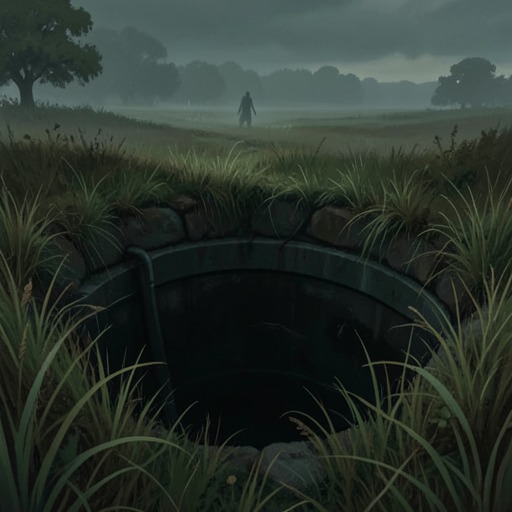
During that walk, Naoko speaks of the field well. Watanabe cannot tell whether it existed outside her mind, but her description permanently fuses it with the meadow in his memory. At the border of grass and woods, the imagined well is a yard-wide, unmarked opening, its weathered, cracked stones muddy-white and its depth impossible to measure. Autumn’s serene openness is thus joined to an image of hidden danger: the meadow seems tangible and remembered, while the well remains unseen and uncertain.
Mountain Autumn and Abandoned Places
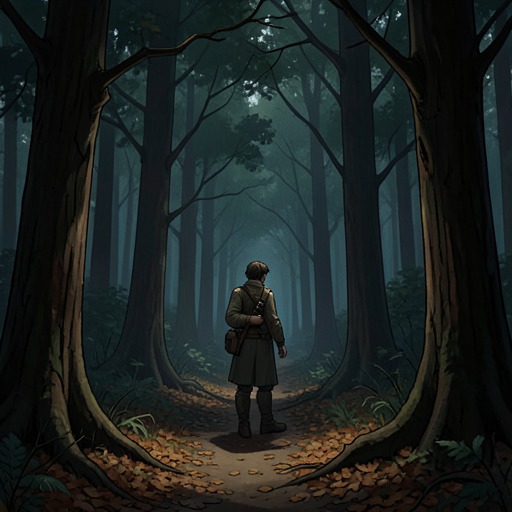
The journey to Ami Hostel moves through an autumn landscape of striking changes. Beyond Kyoto’s streets and fields, the bus winds through a cedar forest so tall and shadowed that the air through its open windows turns suddenly cold and damp. The valley then opens onto green farmland among mountain peaks, with clear water, distant smoke, drying laundry, howling dogs, and firewood stacked at farmhouse fronts. Forest and village alternate along the route, but the bus loses passengers without gaining new ones. The landscape offers quiet and openness, yet also a sense of remoteness.
Later, a trail through waving plume grass leads Watanabe and Reiko past a deserted village. Its dozen or so houses are decaying: grass grows waist-high between them, pigeon droppings cling to walls, and one collapsed building has been reduced to pillars. Reiko explains that people left seven or eight years earlier because winter snow trapped them, the soil was poor, and city life offered a better living. Watanabe sees that some houses could still be used and calls their abandonment a waste. The autumn route therefore carries a human history of hardship and departure alongside its beauty; seasonal quiet does not mean the land is untouched or easy to inhabit.
Autumn as Recollection and Grief
While alone in a room at Ami Hostel, Watanabe remembers an autumn motorbike trip with Kizuki four years earlier. He recalls the smell of Kizuki’s leather jacket, the racket of his red Yamaha, and the sharp wind in his ears as he held on and looked up at the sky. The ride was uneventful, yet lying quietly in the room brings it back with other memories, some pleasant and some shadowed by sadness. Autumn becomes a condition for recollection: stillness in the present opens a passage to scenes that had seemed insignificant when they occurred.
The season also returns in a fine rain at the hostel. The rain is almost invisible, made perceptible by ripples in puddles and dripping eaves; morning mist first encloses the window, then a breeze carries it away and reveals the woods and hills. Naoko and Reiko wear yellow plastic raincapes as the three go out to care for the birds, which huddle at the back of their cage to avoid the weather. This ordinary morning gives the season a shared, practical texture, contrasting with the immense solitude of Watanabe’s remembered meadow and the ruin of the abandoned village.
The Season’s Return
After Naoko’s death, Watanabe travels down the coast, as far from Tokyo as he can get, perhaps in Tottori or on the hidden side of Hyogo. He sleeps on the sand, makes fires from driftwood, roasts fish bought from a local fisherman, and listens to the waves while thinking about Naoko. Although he has heard the coffin’s lid being nailed shut, he cannot absorb that she is dead. Her remembered physical presence remains vivid, intensifying the disjunction between memory and the knowledge that she is no longer alive. The coastal journey extends autumn’s association with solitude beyond the mountains: the landscape offers shelter and routine, but does not resolve grief.
When Watanabe later walks with Reiko, an early-autumn afternoon recalls the clear light of his visit to Naoko in Kyoto a year earlier. He and Reiko share the memory of Naoko, just as he and Naoko once shared the memory of Kizuki; the recognition leaves him unable to continue speaking. Clouds like narrow bones, a high open sky, the breeze’s fragrance, small flowers, and subtle reverberations in sound register the season’s return. Yet each seasonal cycle also increases the felt distance between Watanabe and the dead. Kizuki remains seventeen and Naoko twenty-one in memory, fixed at the ages they reached, while autumn continues to arrive. Its recurrence holds remembrance close even as it makes the separation more palpable.